






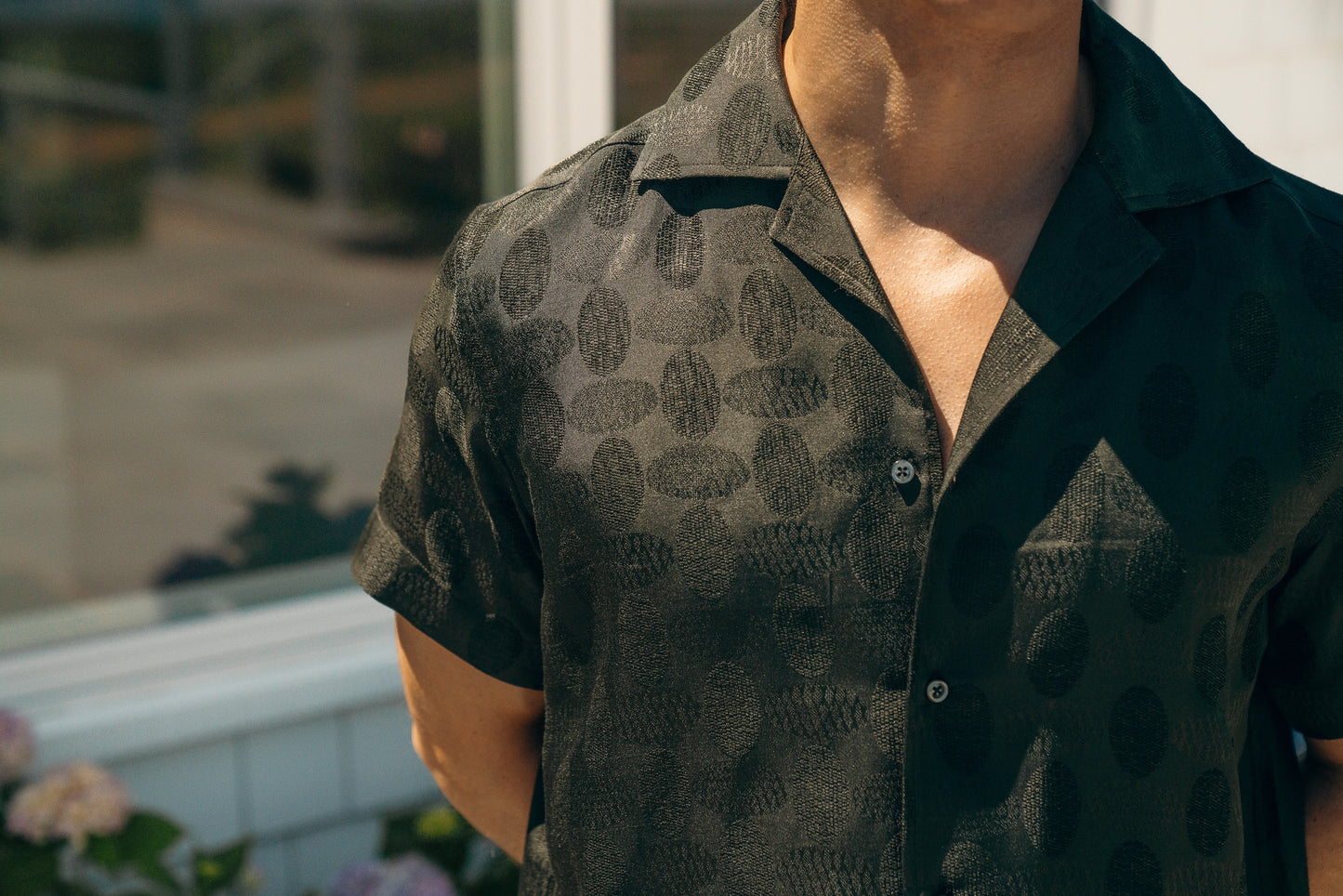


What happens when traditional Japanese tsuri-ami knitting meets a dye house that has spent more than a century working with black? We brought the two together to find out.
Black is probably the most common color in our wardrobes. But place two black fabrics side by side and the differences can be hard to miss. One may look slightly gray, another may lean blue or brown, and another may seem deeper. The fabric matters, as do the dye and the way light reflects from its surface.
Kyoto Montsuki has spent more than a century thinking about those differences. Founded in Kyoto in 1915, the company grew from Kyo-Kuromontsuki-zome, the traditional craft of dyeing formal black kimono fabric. Today, it applies that experience to contemporary clothing. One of its defining techniques is Shinkuro, or Deep Black Finishing, a proprietary treatment applied after the fabric has been dyed black.
We wanted to understand what makes that process different, and bring Kyoto Montsuki’s expertise into garments our customers could wear.

The short-sleeve T-shirt, one of three cotton garments in our Kyoto Montsuki project.
Three garments, two Japanese specialists
For this project, we brought together Toki Sen-I’s traditional tsuri-ami knitting and Kyoto Montsuki’s black dyeing and finishing. The result is a Kyoto Black short-sleeve T-shirt, a Kyoto Black crewneck sweatshirt, and a Kyoto Black pullover hoodie. All three are made from 100% American cotton and knitted in Japan on tsuri-ami circular knitting machines.
The term matters here. Tsuri-ami refers to a particular traditional Japanese knitting machine. It is sometimes described in English as a loopwheel machine, but “loopwheel” is a broader term that can refer to more than one kind of machine. These garments were knitted specifically on tsuri-ami machines.
Toki Sen-I describes its TSURI machines as rare, more than a century old, and slow to produce fabric. We chose them for the fabric they produce, not simply for the history attached to the machinery.
Once the garments were made, they went to Kyoto Montsuki for dyeing and finishing. Each stage contributes something different: American cotton provides the fiber, Toki Sen-I’s machines knit the fabric, and Kyoto Montsuki’s process gives the garments their black appearance.

The long-sleeve crewneck brings the same approach to an everyday layer.
Our interview with Kyoto Montsuki
We asked Kyoto Montsuki about its black dyeing process, Deep Black Finishing, and how the garments change with wear. The seven responses below were provided directly to Wolf vs Goat by Kyoto Montsuki. Additional editorial context is identified separately.
1. Can you explain the dyeing process used to create Kyoto Black?
According to Kyoto Montsuki, the process begins with approximately 90 minutes of black dyeing using reactive dyes. The fabric is then washed to remove excess dye and chemicals, followed by approximately two hours of soaping.
The fabric then undergoes Kyoto Montsuki’s proprietary Deep Black Finishing process. This finishing treatment is one of the defining characteristics of Kyoto Montsuki’s black. Rather than simply dyeing the fabric with black dye, Kyoto Montsuki applies a special chemical treatment after dyeing. This treatment reduces the reflection of light from the fabric’s surface, making the black appear significantly deeper and richer.
Wolf vs Goat context: Kyoto Montsuki’s published garment re-dyeing process describes other stages as well, including inspection, drying, finishing, water extraction, further drying, and a final inspection. The company says craftsmen apply the finishing treatment individually and that garments are dried in sunlight. Those details describe its published re-dyeing procedure; processing can vary depending on the material and garment.
2. What is the biggest difference between Kyoto Black and conventional black dyeing?
The most significant difference lies in Kyoto Montsuki’s proprietary Deep Black Finishing process.
In conventional black dyeing, the primary objective is to color the fabric black using dyes. Kyoto Montsuki, however, takes the process a step further. After the initial black dyeing, the fabric undergoes Deep Black Finishing, which changes the way the black itself is perceived.
During this process, the fabric is impregnated with a special chemical treatment that reduces the reflection of light from its surface.
3. How much do the skills and experience of the craftsmen influence the final result?
When dyeing traditional Japanese kimono fabrics, the experience and intuition of the craftsmen are extremely important. Through techniques developed over many years, they can assess the condition of the material and dye it to achieve a beautiful black.
However, when dyeing Western-style clothing, the final result depends not only on the individual craftsman's manual skills but also heavily on the formulation of the dyes and the development and adjustment of the chemicals used in the Deep Black Finishing process.
At Kyoto Montsuki, we have accumulated extensive knowledge and experience working with black dye for more than 100 years, learning how to work with a wide variety of materials.
This experience has directly contributed to the dye formulations we use today, as well as the development of the chemical treatments responsible for creating the exceptional depth of our black.

A closer look at the crewneck collar and Kyoto Black label.
How does Kyoto Black change with wear?
4. How do garments dyed with Kyoto Black change over years of wear and washing?
Black-dyed garments, whether treated with Kyoto Black or conventional black dyeing methods, may gradually change over time due to wear, washing, friction, ultraviolet exposure, and other environmental factors.
Deep Black Finishing is designed to make black appear deeper by reducing the reflection of light. However, it does not guarantee that the color will remain completely unchanged forever.
The way a garment changes over time depends on several factors, including the fabric's composition, its condition before dyeing, how frequently it is worn, washing methods, and the amount of friction it experiences.
Areas such as cuffs, collars, hems, and seams are particularly susceptible to friction during everyday wear. As a result, these areas may develop changes that differ from those seen on other parts of the garment.
Wolf vs Goat context: Kyoto Montsuki and some retail partners have also described benefits such as resistance to color loss and water repellency. Performance can depend on the material and conditions. Kyoto Montsuki’s own care guidance acknowledges that fading and color transfer can occur, so we would not describe Kyoto Black as fadeproof.
From kimono to contemporary clothing
5. Can you explain the history of Kyoto Black and how the technology developed into what it is today?
Kyoto Montsuki was founded in 1915 and has specialized in black dyeing for more than 100 years.
Our origins lie in a traditional Kyoto dyeing technique known as Kyo-Kuro Montsuki-zome, the traditional art of dyeing formal black kimono fabric.
A kuro montsuki is a formal black kimono featuring a family crest. These garments have historically played an important role in Japanese ceremonial culture, including weddings, funerals, and other formal occasions.
The black required for these garments was never simply about making the fabric dark. It needed to be a deep, beautiful black appropriate for clothing worn at the most formal and important occasions.
However, as lifestyles and clothing traditions changed over time, demand for traditional black formal kimono declined significantly.
Western-style clothing became increasingly common, and the garments worn at weddings, funerals, and other ceremonies evolved. As a result, the need for traditional black montsuki kimono decreased considerably.
In response, we began exploring ways to apply the black dyeing techniques we had developed over generations to products beyond traditional kimono.
Today, in addition to dyeing traditional kimono fabrics, we also provide black dyeing services for contemporary apparel, as well as services that allow customers to have their existing garments re-dyed black.
Furthermore, as part of our ongoing pursuit of achieving a deeper and more beautiful black, we have developed our Deep Black Finishing technology, which involves applying a specialized treatment after the initial dyeing process.
Wolf vs Goat context: That adaptation is part of what drew us to the project. Re-dyeing also gives some existing garments another chance to be worn, though it does not by itself establish that the dyeing process has a lower environmental impact.
A black like a black hole
6. Are there any common misconceptions or misunderstandings about Kyoto Black?
Kyoto Black is not yet widely known among the general public, so we cannot think of any particular misconceptions or misunderstandings at this time.
7. For craftsmen who have dedicated their lives to working with black, what is the perfect black?
For us, the ultimate black would be a black like a black hole.
Imagine a black that seems to absorb all light, where reflections are reduced to their absolute minimum, creating the sensation that you are being drawn into the darkness itself.
Our ideal black would be so deep that even the surface and shape of the object might seem to disappear.
Of course, in actual textile dyeing, it is impossible to create a black that completely absorbs all light or makes the physical shape of an object invisible.
Nevertheless, our goal is to get as close to that ultimate black as possible.
Generally speaking, people think of black simply as a dark color. But what we are pursuing is not merely a darker shade of black.
We are seeking a black that minimizes the reflection of light and creates a sense of depth and richness.
Kyoto Montsuki's Deep Black Finishing is a technique in which specially developed chemical treatments are applied to dyed fabric to reduce light reflection, allowing us to achieve a deeper expression of black.
For those of us who have spent our lives working with black, black is more than just a color.
How deep can we make it? How close can we come to our ideal black?
There is no end to that pursuit.
What we strive to create is a black so deep that it seems capable of absorbing even light itself.
A black like a black hole.
That is the ultimate black Kyoto Montsuki continues to pursue.

The pullover hoodie completes the three-piece project.
What this means for our collection
These three garments bring together American cotton, traditional Japanese tsuri-ami knitting, garment construction, and Kyoto Montsuki’s black dyeing and finishing. We wanted each choice to contribute something to the finished pieces.
It is easy to look at a black T-shirt and assume there is not much of a story behind its color. This project has been a reminder that there can be a great deal behind something so familiar: a dye house’s history, the chemistry of a finishing process, the character of the knitted fabric, and the people who have spent years learning how to work with both.
Kyoto Montsuki’s ideal black may be impossible to reach completely. What we appreciate is the continued effort to get closer, and the chance to bring some of that pursuit into garments made for everyday wear.
After all, how much more can you do with black? Apparently, quite a lot.
Explore the Kyoto Black pieces
Discover the three garments behind the story: the Cotton Short Sleeve Crewneck Tee Kyoto Black, Cotton Crewneck Sweatshirt Kyoto Black, and Cotton Hoodie Kyoto Black.
Further reading
The seven interview responses above were provided directly to Wolf vs Goat by Kyoto Montsuki. Additional historical and technical context was checked against:
- Kyoto Montsuki: Official explanation of Deep Black Finishing
- Kyoto City: Profile and interview with Kyoto Montsuki
- Japan’s Ministry of Economy, Trade and Industry: Kyoto Montsuki, Tradition and Innovation
- Toki Sen-I: Factory and equipment
- LOOPWHEELER: Explanation of tsuri-ami and loopwheel terminology
- Kyoto Montsuki: Processing and material guidance
Technical note: Statements about Kyoto Montsuki’s proprietary process and product performance reflect explanations from the company or published interviews. This article does not establish the precise chemical formulation or independently measured optical and durability characteristics of the finished Wolf vs Goat garments.