




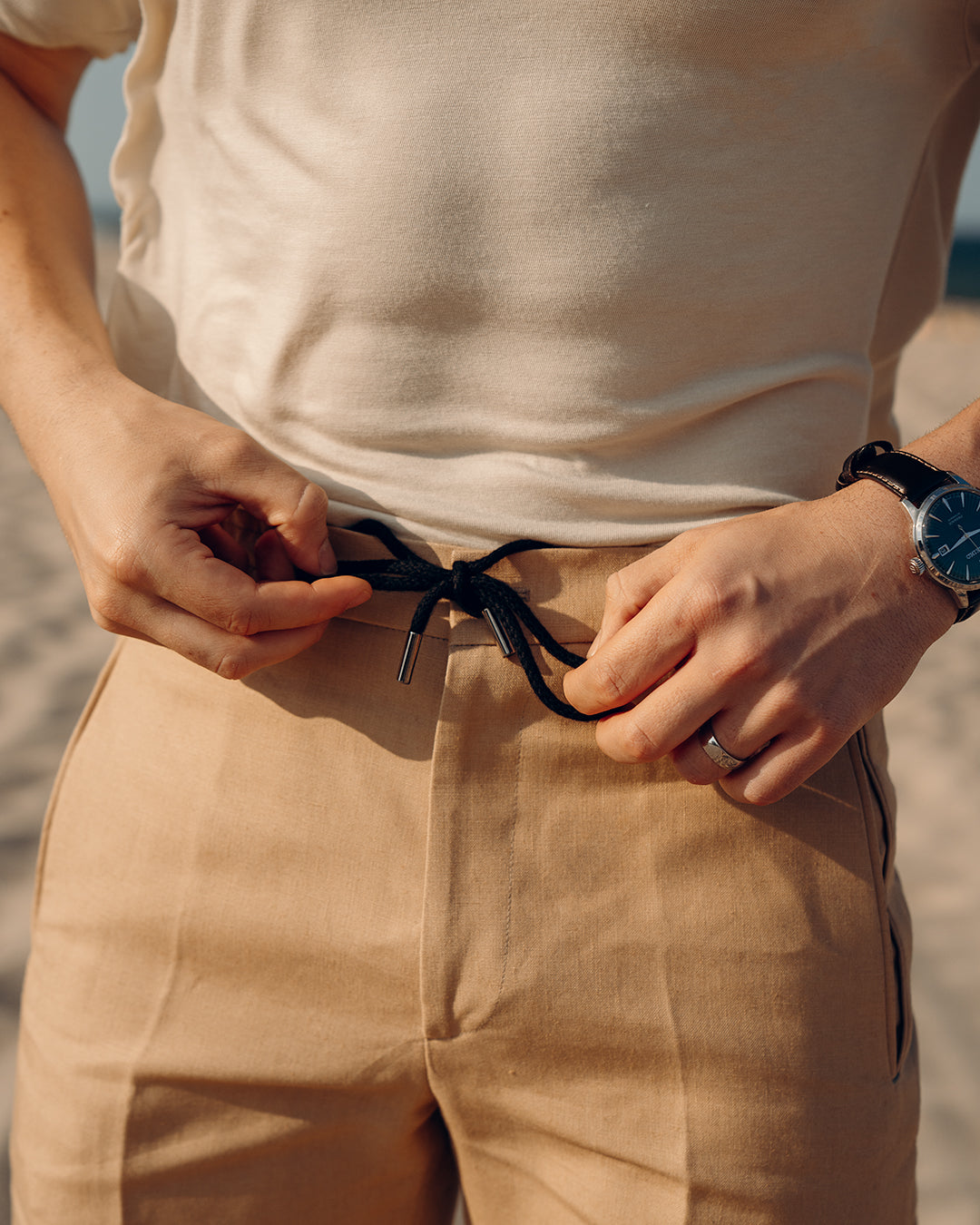



Almost every pair of wool trousers you own says dry clean only on the label. Most of the time that is a legal position rather than a technical one, and it is costing you money and quietly wearing your trousers out. Here is what is actually true about washing wool trousers, where the label is right, and how to do it at home when it is not.
The short answer, and the one case where it is no
Most wool trousers can be hand washed at home in cold water with a wool detergent, squeezed rather than wrung, and dried flat away from heat. What you must not do is agitate them in warm water or put them in a tumble dryer, which is what actually shrinks wool. The exception is a tailored trouser with internal structure, where washing can distort the shaping and dry cleaning is genuinely the right call.
Why the label says dry clean
Three reasons, and only one of them is about the wool.
The first is liability. A manufacturer who prints dry clean only cannot be blamed for what happens in your machine. It is the safest instruction to give a stranger, so it gets printed by default on almost everything containing wool.
The second is construction rather than fiber. A tailored trouser can contain internal components that were shaped with heat and pressure during making. Soaking and drying those can shift them relative to the outer cloth, and the result is a trouser that never hangs the same again. This is a real risk and it is the one case where the label deserves respect. If you want to understand what is inside a properly made trouser, read how our trousers are made.
The third is dye. Deeply dyed wool can bleed, especially the first few times. Worth noting that this is not universal. The Loro Piana Pecora Nera cloth in our Lorenzo takes its color from naturally dark fleece rather than from dye, which means there is nothing in it to run.
Against all that, dry cleaning solvent strips the natural lanolin out of wool over time and leaves the fiber drier and more brittle with every visit. Dry cleaning a wool trouser after every wear will age it faster than washing it carefully ever would.
Washing wool trousers at home, step by step
1. Check the composition first. Plain wool and wool blends with silk, linen or cotton are generally fine. If the trouser is heavily structured or tailored for formal wear, stop here and take it in.
2. Turn the trousers inside out and close any fastenings, so the hardware cannot catch the cloth.
3. Fill a basin with cold water. Not warm, not lukewarm. Temperature change is one of the two things that felt wool.
4. Add a small amount of detergent formulated for wool. A capful is enough.
5. Submerge the trousers and press them gently under the water a few times. Do not rub, scrub, twist or swish. Agitation is the other thing that felts wool, and it is irreversible.
6. Leave them for around ten minutes, no longer.
7. Drain and refill with cold water to rinse. Press through again. Repeat until the water runs clear.
8. Press the water out against the side of the basin, then lay the trousers on a dry towel, roll the towel up, and press. Never wring them.
9. Reshape while damp, matching the inseam to the outseam so the leg falls naturally, and dry flat or over a bar away from direct heat and sunlight.
Machine washing is possible on a genuine wool or hand wash cycle with cold water and the lowest spin, and some wool trousers survive it perfectly well. It is still a bigger risk than a basin, and the failure mode is permanent.
What shrinks wool and what does not
Wool does not shrink because it got wet. It shrinks because its fibers have microscopic scales that open with heat and moisture, then interlock permanently when the fabric is agitated. That process is called felting and it cannot be reversed.
So the culprits are heat, temperature change and mechanical agitation, in combination. Cold water on its own does very little. A tumble dryer combines all three at once, which is why it is the single most reliable way to destroy a wool garment. Yes, 100% wool will shrink in a dryer, and usually dramatically.
This also explains why superwash and machine washable wools exist. The scales have been chemically smoothed or coated so they cannot interlock. If the label says machine washable wool, believe it.
Detergents, and the dish soap question
Use a detergent made for wool, which will be pH neutral and free of the enzymes that break down protein. That is the whole requirement.
Ordinary laundry detergent is usually alkaline and frequently contains protease enzymes designed to digest protein stains. Wool is a protein fiber, so those enzymes will slowly digest the trousers. It will not be visible after one wash and it will be visible after ten.
On the dish soap question, no. Dish soap is a degreaser, which is precisely the wrong tool for a fiber whose condition depends on retaining its natural oils. It will strip the wool and leave it harsh. The same logic applies across natural fibers generally, which we cover in our fabric care guide.
Drying and pressing without losing the line
Dry flat or hung over a rounded bar, never on a hanger by the waistband while sopping wet, because the weight of the water pulls the trouser out of shape.
Reshape while damp. Line the inseam up with the outseam, smooth the front, and let the leg dry in the position you want it. Half the pressing work is done at this stage if you do it properly.
Once dry, press with a cloth between the iron and the wool, using the wool setting and steam. Never put a hot iron directly onto wool, which causes permanent shine. Hang by the cuff afterwards and the leg will straighten itself.
How often wool trousers actually need washing
Far less often than most people think. Wool resists odour and sheds dirt naturally, and a pair worn a few hours at a time will go a surprisingly long stretch between washes.
Air them after each wear instead. A day hanging in open air removes most of what a wash would, and it costs the fiber nothing. Spot clean marks as they happen with cold water and a little wool detergent on a cloth, working from the outside of the mark inward. Wash the whole garment only when it genuinely needs it.
Rotation is the other half of this. Two pairs worn alternately will each outlast two pairs where one does all the work, because wool needs recovery time to return to shape. If you are thinking about that, our merino primer explains why the fiber behaves the way it does, and you can see the wool pieces we make.
FAQ
Can 100% wool pants be machine washed?
Some can, on a genuine wool or hand wash cycle with cold water and the lowest spin. Unless the label says machine washable, hand washing in a basin is much safer and the failure mode of getting it wrong is permanent.
Why are wool pants dry clean only?
Usually liability rather than necessity. The genuine reasons are internal tailored structure that can shift when wet and dyes that may bleed. Plenty of wool trousers carrying that label wash perfectly well by hand.
Do wool pants shrink in the dryer?
Yes, badly. A tumble dryer combines heat, moisture and agitation, which is exactly the combination that felts wool. It is the most reliable way to destroy a wool garment and it cannot be undone.
Does 100% wool shrink when washed?
Not from water alone. It shrinks from the combination of heat, temperature change and agitation. Cold water with gentle handling and no rubbing will not shrink it.
Can I wash wool with Dawn dish soap?
No. Dish soap is a degreaser and wool depends on its natural oils. It will strip the fiber and leave it harsh. Use a pH neutral wool detergent with no enzymes.
Air them more, wash them less, and keep them out of the dryer. That covers most of it. Browse the trousers if you are looking for a pair worth taking care of.