


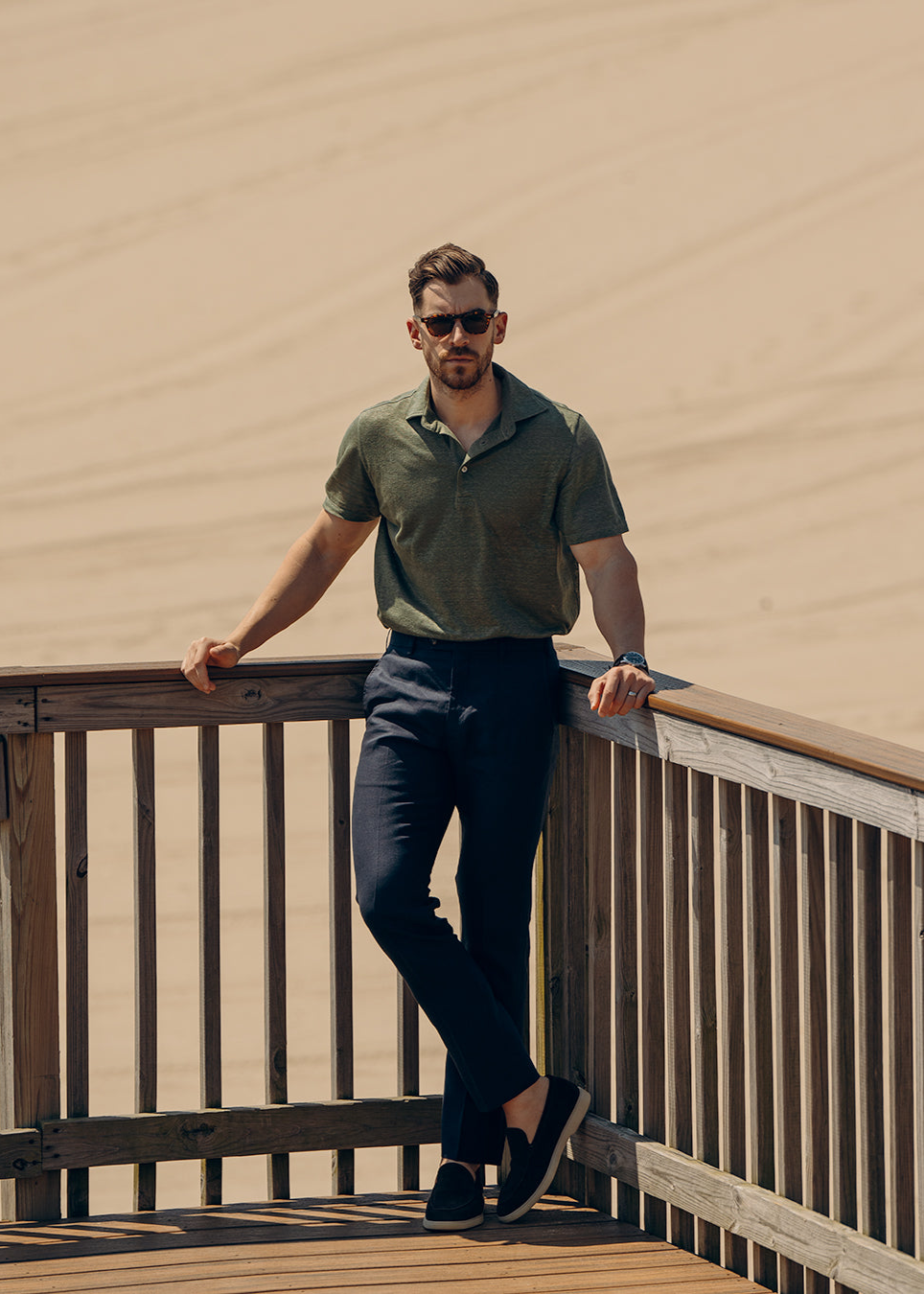

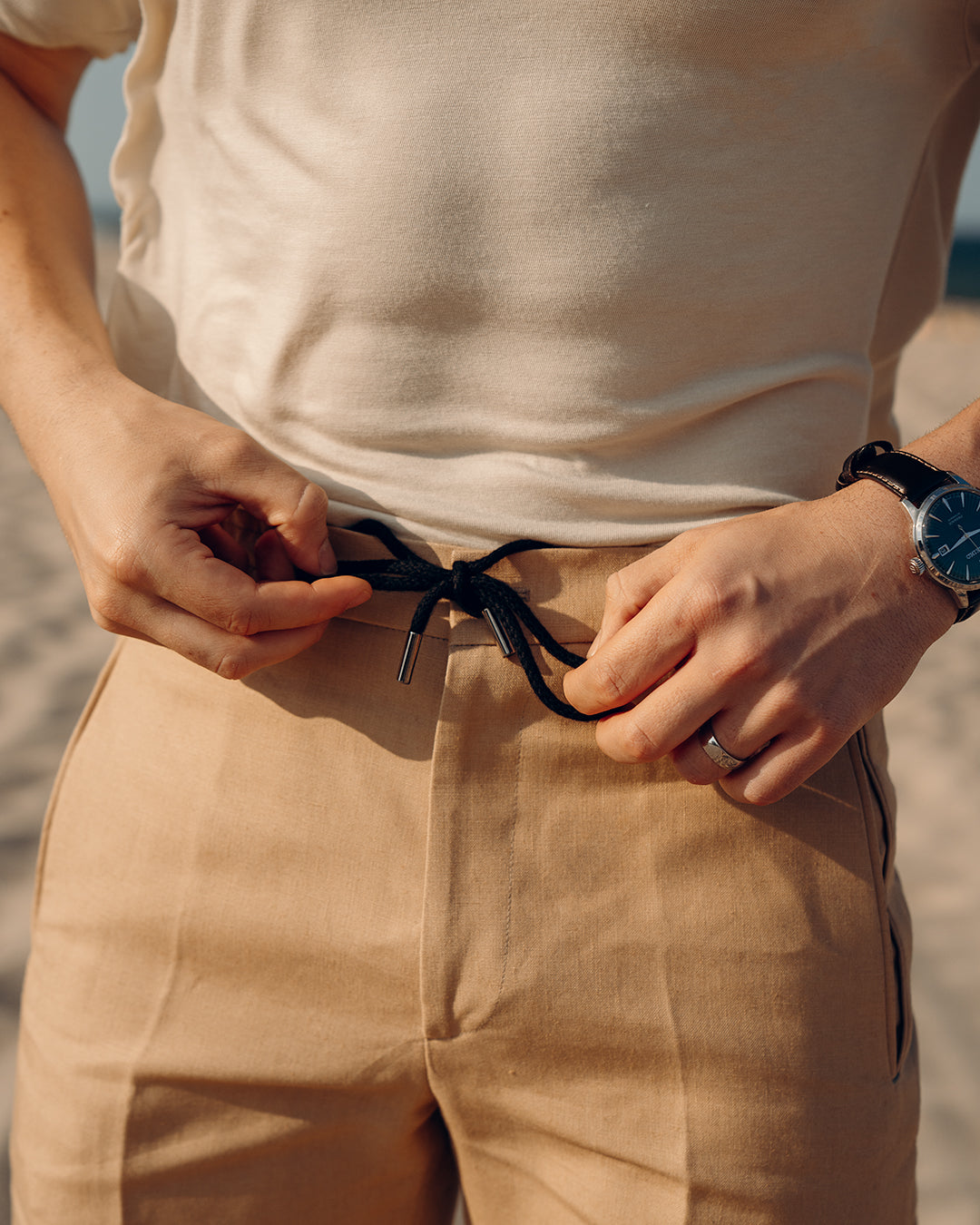



Our trousers arrive with the hem unfinished. That surprises people the first time, so it is worth saying plainly why we do it. Everyone's leg is a different length, everyone wears different shoes, and break is a preference rather than a rule. We would rather send you a trouser that is deliberately long and let you set the length with a tailor than send you a factory guess that is wrong for you and impossible to lengthen.
Break in one paragraph
Break is the fold, or crease, that appears at the front of the trouser leg where the hem meets the top of your shoe. It happens because the trouser is longer than the distance from your waist to your shoe, so the excess has to go somewhere. More length means more fold. The amount of fold you choose is the break.
That is the whole concept. Everything else is naming the amounts.
The five lengths, from none to full
No break
The hem finishes at or just above the top of the shoe with no fold at all. The leg line stays completely clean and the ankle is visible when you walk. It is the sharpest look and the least forgiving, because a no break hem that is even slightly short reads as a mistake rather than a choice.
Slight or shadow break
A small dent in the fabric rather than a fold. The hem rests on the shoe just enough to interrupt the line. This is the most flattering length for most people and the safest instruction to give a tailor if you are not sure.
Quarter break
One soft fold across the front of the leg. Traditional, comfortable, and forgiving of an imperfect measurement. If you sit a lot, this keeps the sock covered when you cross your legs.
Half break
A fuller fold with the hem sitting well onto the shoe. Common on heavier trousers and on cuts with more leg width, where a shorter hem would leave the leg opening looking like it is floating.
Full break
The hem covers most of the shoe and stacks. It reads as older tailoring and it does the leg line no favors, but it is the right answer on a genuinely wide trouser where anything shorter would look truncated.
Choosing a break for your shoes and leg line
Two variables do most of the work here, and neither one is fashion.
The first is the width of the trouser at the hem, the leg opening. A narrow opening needs less length, because there is less fabric to fold and it folds badly. A wide opening needs more, because a wide leg finishing short leaves an obvious gap of air between the hem and the shoe. Match the break to the width you are actually wearing, not to a number you read somewhere.
The second is the shoe. A slim leather shoe with a low profile sits lower than a chunky derby or a boot, so the same trouser breaks differently on each. If you have one pair of shoes you wear with a given trouser most of the time, hem it wearing those, not whatever you had on the day you visited the tailor.
Heavier cloths hold a fold and lighter ones do not. A wool flannel will take a clean quarter break and keep it. A dry linen will crumple wherever it lands regardless of what you asked for, which is worth accepting rather than fighting.
What to tell your tailor
Go in wearing the shoes. Stand normally, do not brace, and let the tailor pin while you are standing rather than while you are perched on a stool. Then walk a few steps and let them look again, because a hem that is right standing still can be wrong in motion.
If standard sizing has never worked for you, explore made to measure instead of hemming your way around a pattern that was never yours.
Ask for the break by description rather than by inches. Saying you want a slight break with these shoes gets you a better result than asking for a 32 inch inseam, because the inseam that produces a slight break changes with the trouser and the shoe. Our trousers come long precisely so the tailor has room to work, and a good one will also tell you if the leg opening wants adjusting at the same time. If you do not have someone you trust yet, we have written about finding a tailor before.
One practical note. Get the hem finished before you decide the trousers do not fit. A great deal of what people read as a fit problem is length, and length is the cheapest thing on a trouser to correct.
Why unfinished is the better default
A finished hem is a decision the factory made for you, on the assumption that your leg matches an average and your shoes match a guess. We would rather not make that decision. It costs us something to ship trousers that need a trip to a tailor before they are wearable, and we do it anyway because the alternative is a trouser that is right for almost nobody.
You can see the rest of the thinking in how our trousers are made, and the measurements you will want before your fitting are on the trouser size chart.
FAQ
What is a trouser break?
The fold that forms at the front of the trouser leg where the hem meets the shoe, caused by the trouser being longer than the distance from your waist to your shoe. The size of that fold is the break.
What are the different types of breaks in pants?
No break, slight or shadow break, quarter break, half break and full break, in order of increasing length. Slight and quarter are the most wearable for most people.
Is it better to have a break or no break jeans?
For jeans, a slight break or none at all usually works best, because denim is stiff and stacks awkwardly. Cuff them or hem them rather than letting the excess pile onto the shoe.
What is the 2 finger rule for pants?
It is a waistband check, not a length check. You should be able to slide two fingers between the waistband and your body comfortably. It says nothing about break, so do not use it to decide your hem.
If you are picking a new pair, look at the leg opening before you look at the length, then hem to suit it. The Roberto is a good place to start, or see the trouser range in full.