







Most fit advice for dress trousers is written by people who have never cut a pattern. It tends to describe a look rather than a fit, which leaves you no way to tell whether the pair you are wearing is wrong or just unfamiliar. What follows is the version we would give someone standing in our fitting room, working through the places a trouser either fits or does not.
The short answer
Dress trousers should sit at or just above your hip bone without a belt holding them up, skim the seat without pulling or sagging, allow you to pinch about an inch of spare fabric at the thigh, and fall to the shoe with the amount of break you have chosen. If any one of those is wrong, the fault is usually the waist or the rise, not the size on the label.
Waist, and why the two finger rule is only a start
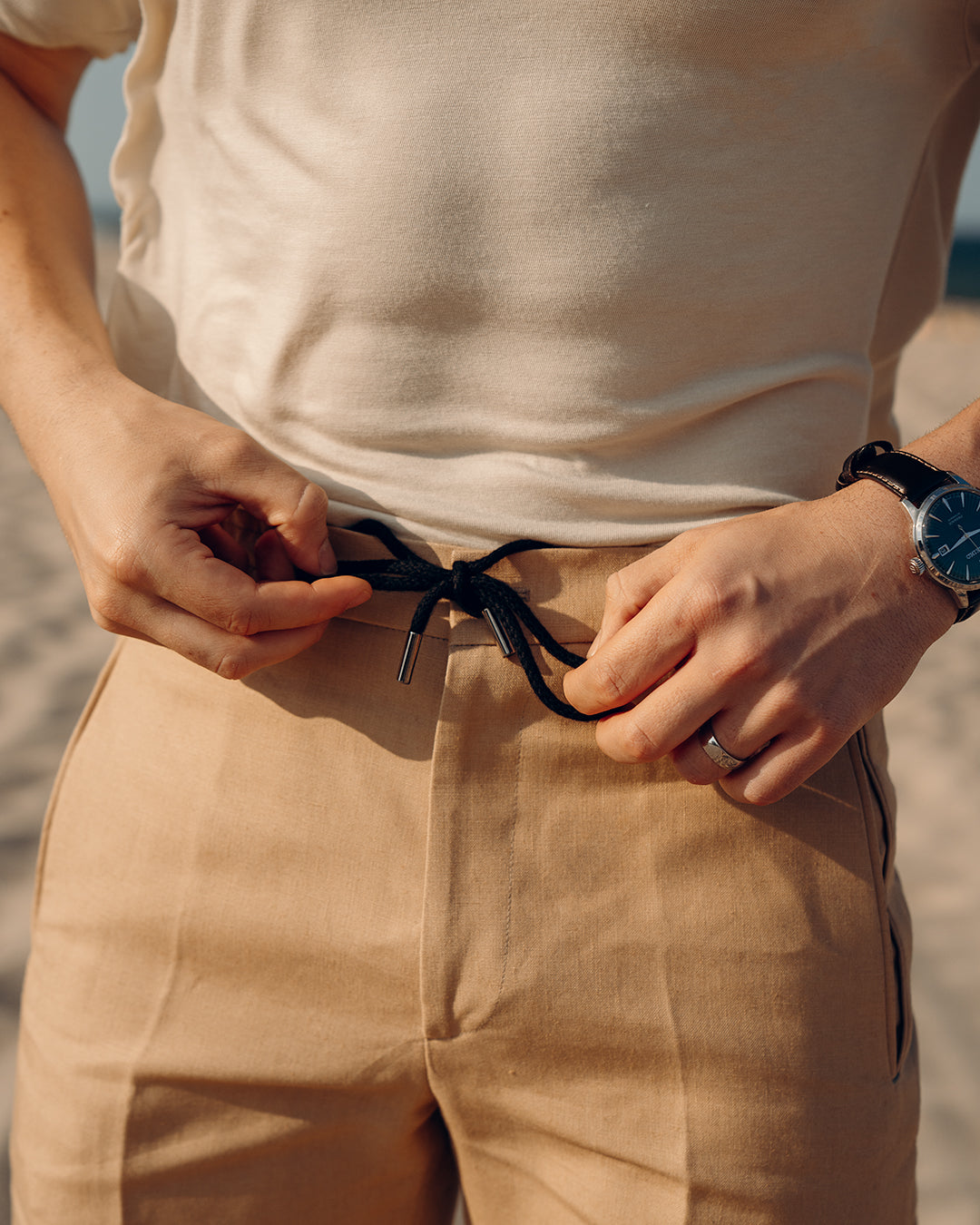
The waistband should stay where you put it when you are standing still and when you sit down. That is the test. A belt should be a finishing detail, not the thing preventing an incident.
The two finger check is a reasonable starting point. Slide two fingers between the waistband and your body, and if they go in comfortably but not loosely, the circumference is roughly right. What it will not tell you is whether the waistband is sitting in the right place, and that is the more common failure. A waistband that keeps rolling over or sliding down is usually not too big. It is sitting on your hips instead of near your natural waist, and no amount of taking it in will fix a trouser that is anchored on a slope. We have written a separate piece on rise if that sounds like your problem, and it is worth checking the trouser size chart against a pair that already works for you.
One more thing the finger test misses. Sit down before you decide. A waistband that is comfortable standing and cuts in when seated is too tight, and it will be uncomfortable for the entire time you own it.
Seat and thigh
The seat should follow the shape of your backside with the fabric touching but not gripping. If you see horizontal pulls across the back, the trouser is too tight through the seat. If there is a hammock of loose cloth hanging under it, too loose. Both are fixable by a tailor within limits, and the limit is how much seam allowance was built in, which is one of the things separating a well made trouser from a cheap one.
For the thigh, pinch the fabric at the widest point of your leg while standing. Roughly an inch of spare cloth on each side is a classic fit. Less and you will see the leg through the trouser and it will pull when you walk. More and the leg reads baggy and the drape collapses.
Watch what happens when you walk rather than only when you stand. A trouser that looks correct in a mirror and grips the thigh with every step is too narrow, whatever the tape says. If you want the longer view on why we care about any of this, read why fit matters.
Where the leg line should fall
From the widest point of the thigh, a dress trouser should taper gently and evenly to the hem. Gently is the operative word. An aggressive taper makes the thigh look larger by contrast and creates a cone shape that reads cheap.
The leg opening should be wide enough to fall cleanly over your shoe without clinging to the ankle and narrow enough that it does not flap. There is no single correct number, because it depends on the width of the trouser above it and on your own proportions. What is not negotiable is that the opening and the thigh should be in proportion with each other. A narrow hem on a full thigh, or a wide hem on a slim leg, is what makes an otherwise decent trouser look wrong in a way people struggle to name.
Length, and whether they should touch your shoes
Yes, in almost every case dress trousers should touch the shoe. How much they touch is your choice, and it is the choice we cover in our piece on break. The short version is that a slight fold at the front is the most flattering and most forgiving option for most people.
Our own trousers ship with the hem unfinished so this is genuinely your decision rather than a factory default. That is also why we would rather you judged the fit of a new pair after the hem is done, not before.
Loose, tight, and the honest middle
A little loose is acceptable and a little tight is not. That is the practical answer to a question people ask constantly.
Slightly generous trousers drape, move, wear comfortably for a long day, and age well because the fabric is not under constant tension. Slightly tight trousers pull at the seat and thigh, wear through at the stress points faster, and look worse the longer you stand in them. If you are genuinely between two sizes and can only pick one, take the larger and have the waist taken in. A tailor can remove cloth. Nobody can add it.
Baggy is a different matter from generous. If the seat is empty, the thigh has three inches of spare cloth and the waist needs a belt cinched hard, that is not a relaxed fit, it is the wrong trouser.
What a tailor can change and what they cannot
Straightforward for a competent tailor. Waist circumference, seat, hem length, and tapering the leg below the knee. All are routine and all are cheap relative to the cost of a good trouser.
Difficult or not worth doing. Rise, the thigh above the knee, and the shape of the seat itself. These are pattern decisions rather than alteration decisions, which is why a trouser that is wrong in the rise is worth returning rather than reworking. If your proportions have never matched a standard block, made to order and made to measure is the honest answer rather than a series of expensive compromises.
It also helps to know what you are altering. A trouser with real seam allowance and properly reinforced stress points gives a tailor room to work, which is one of the practical reasons how our trousers are made affects how they fit five years from now. The Roberto is cut with adjustable metal side tabs, which handles small waist changes without a trip to anyone.
FAQ
Are dress pants supposed to be tight or loose?
Neither. They should skim without gripping, with roughly an inch of spare fabric pinchable at the thigh. If forced to choose, slightly loose is far better, because a tailor can take cloth out and cannot put it back.
What is the 2 finger rule for pants?
Two fingers should slide between the waistband and your body comfortably. It is a rough check on waist circumference only, and it tells you nothing about where the waistband is sitting or how the trouser fits below it.
What is the 2 3 rule for pants?
An informal guideline that you should be able to pinch about two inches of fabric at the seat and about three at the thigh on a classic cut. Treat it as a sanity check on a fuller trouser rather than a standard, since it does not hold on slimmer cuts.
Are dress pants supposed to touch your shoes?
Yes, in nearly all cases. How much they touch is the break, and a slight fold at the front suits most people. A hem floating clear of the shoe reads as accidental unless the whole trouser is cut for it.
Is it okay for dress pants to be a little baggy?
A little generous is fine and often better. Genuinely baggy is not, and the tell is an empty seat with a waistband that needs a belt pulled tight to stay up. That is the wrong trouser rather than a relaxed one.
Work through the five checks on a pair you already own before you buy anything new, then browse the trousers with the numbers in hand.