


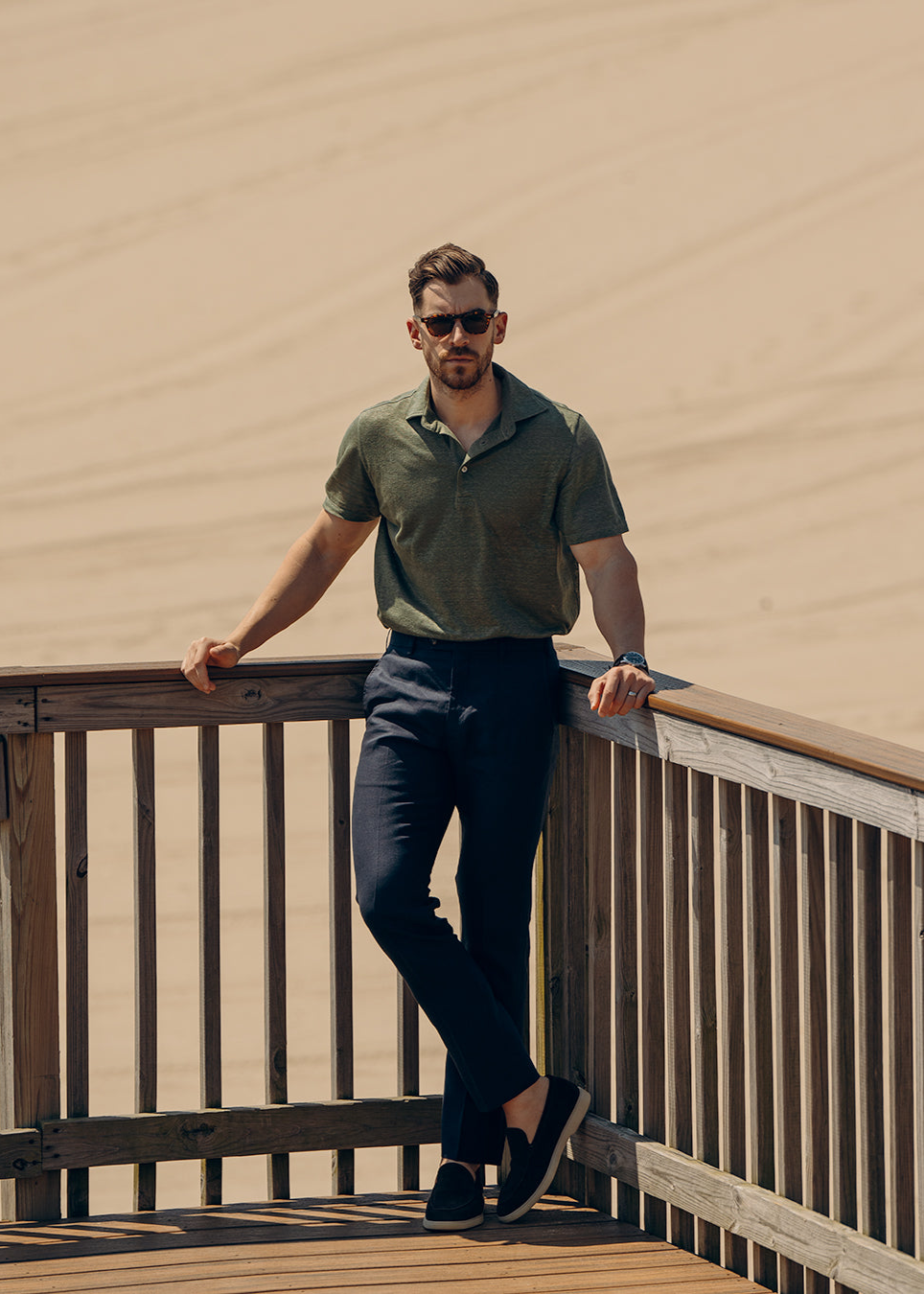




We make both, and we've chosen trouser by trouser. Our cargo pants are flat front. Every tailored trouser we cut at the moment is pleated, with one pleat or two. That isn't a statement about fashion. It's what each of those trousers has to do, and it's the fastest way to settle the pleated versus flat front question for yourself.
The short answer
Go flat front on slim, casual trousers, where a clean line matters more than room. Go pleated for a higher rise, a fuller seat or thigh, a crisp cloth that holds a fold, and anything you'll sit in all day. Both are current. A pleat is a working part of the trouser, not a period detail, and it earns its place on some trousers and not on others.
Side by side, the difference comes down to three cuts.
- Flat front. No folds below the waistband. The cleanest, slimmest line, with its room built into the leg or left out altogether. Best on casual and slim cuts in lighter cloth.
- Single pleat. One fold each side. Real room through the hip and thigh with very little visual weight. It suits almost everyone, including people who think they dislike pleats.
- Double pleat. Two folds each side. The most room and the most presence. It needs a higher rise and a leg that narrows toward the hem, or it reads as volume for its own sake.
What a pleat is actually for
A pleat is a fold of extra cloth at the waistband that opens down into the body of the trouser. It adds room across the hip and thigh without adding bulk at the waist, so the trouser can fit closely at the top and still let you walk, sit and take the stairs.
That's all a pleat is for. It was never decoration, and it was never really about formality. A trouser fitted at the waist and cut for a full stride has to find its extra cloth somewhere, and folding it at the top is the least visible place to put it.

There's a simple check for whether a pleat is working. Stand still and look down. The pleat should lie closed, folded neatly into the crease.
If it pulls open, the trouser is too tight through the hip or seat, and the pleat is being asked to do the job of the fit. Size up, or have the seat let out, before you decide pleats don't suit you. It's the most common reason people give up on them.
Flat front, and what the clean line costs you
Flat front means no fold at all. The cloth runs straight from the waistband down the front of the leg, which gives the cleanest possible line and reads slimmer and more modern.
What you give up is room. A flat front has to take its movement allowance from a wider leg, or it goes without. That's why slim flat fronts are the ones that pull across the thigh when you sit and crease hard at the hip when you stand back up. On a slim, light, casual trouser that's a fair trade. On a full cut in a heavy cloth it isn't.

Our cargo pants are flat front for exactly that reason. They're 100% cotton herringbone, garment dyed, with a button fly and slash pockets, and the leg is cut straight enough that the room is already there. A pleat would add nothing to them but fuss, so see the cargo pants if a clean front is what you're after.
Flat front is also unforgiving of a waist that changes. There's no fold to absorb an inch either way, so the fit at the waist has to be right on day one.
Single, double and reverse pleats
Single pleat
One fold on each side. It adds useful room without much visual weight, and it's the version most likely to win over someone who thinks they dislike pleats. The Lorenzo is cut this way, in Loro Piana Pecora Nera, a blend of 76% virgin wool, 12% silk and 12% linen whose color comes from naturally dark fleece rather than dye. It's the trouser we point people to when they want the function without the volume, so shop the Lorenzo if that sounds like you.
Double pleat
Two folds on each side, with considerably more room and considerably more presence. The rule we cut by is simple. A double pleat needs a higher rise and a leg that narrows from a full hip to a clean hem. Get that right and the pleats read as shape, but leave the leg full all the way down, or drop the rise, and they read as volume.

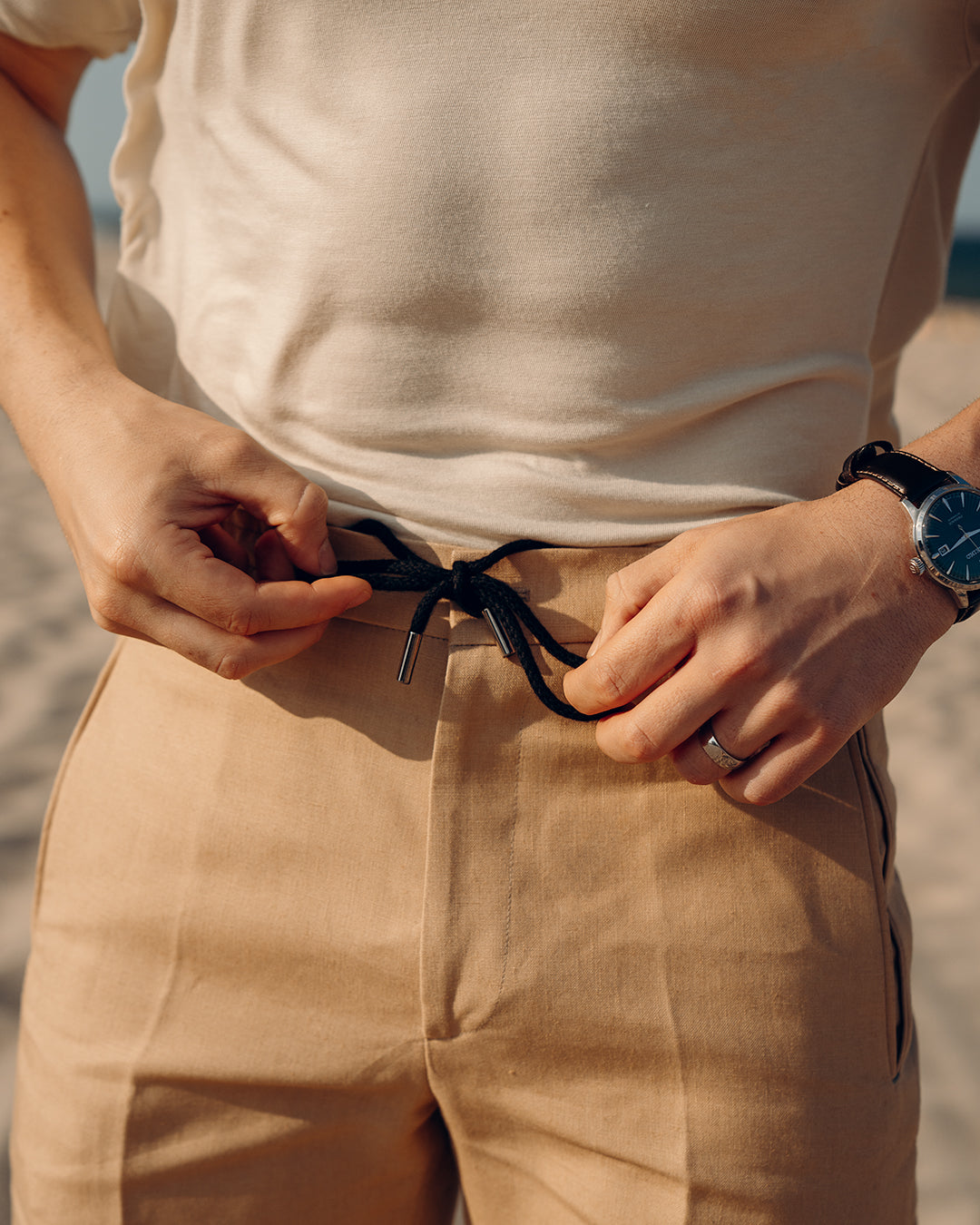
The Roberto is our double pleat, in 100% European linen woven in Italy, with adjustable metal side tabs at the waist. Linen is crisp enough to hold a fold, and the tabs let you take the waist in or out a little without a belt. See the Roberto for how the two pleats sit on a tapered leg.
Forward, reverse and kissing pleats
A forward pleat opens toward the fly. A reverse pleat opens toward the pocket. Reverse pleats lie flatter and show less, which is why most contemporary pleated trousers use them, while forward pleats are the older English convention and read more traditional.
A kissing pleat is two folds that meet edge to edge, so the extra cloth gathers between them. It keeps both sides of the leg tidy, but it gives up the sharp line of a pleat running straight into the crease. None of these is worth agonizing over, so get the rise and the cloth right first.
Cloth decides more than the pleat does
A pleat only works if the cloth will hold a fold. Crisp, dense weaves such as worsted wool and linen take a pleat and let it close again when you stand. Soft, loose cloths like moleskin, most tweeds and many chino cottons let a pleat drift open and stay open, and then it's doing neither of its jobs.

Weight matters too, in a different way. A heavier cloth drapes, so a pleat hangs straight rather than flaring. Our corduroy is an Italian cloth from Drago, 92% cotton and 8% wool, and the wool is there for recovery, so it springs back into shape after a day's wear. A heavy pile in a full cut needs the room a pleat gives it, and the waistband is fully tailored so it can be let in or out later. Shop the corduroy trousers to see a pleat in a pile cloth.
Rise, braces and how to wear a pleat
A pleat needs rise to hang from. On a trouser that sits at or near your natural waist, there's enough cloth for the pleat to open and close properly. On a low rise it has nowhere to go and sits bunched at the hip. If you're not sure where your natural waist is, read our guide to trouser rise before you choose.
Braces and side tabs suit pleats for the same reason. Braces fasten close to the top of the pleats and keep them under light tension, so they stay closed. Side tabs do a quieter version of the same job by holding the waist where it's meant to sit.
A few habits make pleats look intentional rather than accidental.
- Tuck the shirt in. A pleated front is designed to be seen at the waist.
- Keep the break light, so the crease runs clean from the pleat to the hem.
- Consider a turn-up. The small weight at the hem helps the leg hang straight, and it's a natural partner for a pleat.
- Fit the waist first. A pleat can't fix a waistband that's too big or too small.
For the rest of the measurements, see how dress trousers should fit.
Body type, and why the usual advice is half wrong
The standard line is that pleats suit larger builds and flat fronts suit slim ones. It's half right, and it causes a lot of bad purchases.
The accurate version is that pleats suit anyone who needs room through the hip and thigh relative to their waist. That includes people with a larger seat, people with muscular legs, and people who simply sit down for a living. Plenty of slim, athletic people are far better served by a single pleat than by a flat front, because the gap between their waist and their thigh is exactly what a pleat exists to solve.
Where the old advice does hold is at the extremes. Double pleats on a very slim frame add volume where there's nothing to fill it. A slim flat front on a larger build has to be cut wide enough to fit, and then it has no way to hide it.
Where pleats have been, and why they look new again
For the first half of the twentieth century most tailored trousers were pleated, and they were cut high and full. The oversized suits of the 1980s and early 1990s pushed deep double pleats onto low rises and baggy legs, which is where most people's bad memories of pleats come from. The slim, low, flat front trouser then took over through the 2000s and 2010s. Over the last several years pleats have come back, alongside higher rises and wider legs.
So they're current. Whether pleats are in is still the wrong question, though, because a trouser bought on a trend is a trouser you'll be embarrassed by on the next one. Ask whether the trouser in front of you is built to use a pleat. A higher rise, a cloth that holds a fold and some room in the leg, and the pleat is doing a job. A low rise, a soft thin cloth and a narrow leg, and it's a costume detail.
What we cut, and why
Every tailored trouser we make right now is pleated. The Lorenzo has a single pleat, the Roberto a double, and the corduroy a single pleat in a heavy pile. Each is made in Italy and left with a 36 inch unfinished inseam, so it can be hemmed to exactly the break you want. Our cargo pants are the flat front in the range, because a workwear trouser in herringbone cotton gets its room from the leg.

If you want the reasoning behind how each one is built, read how our trousers are made. Then browse all our trousers and judge the cuts against each other rather than against the argument.
FAQ
Are pleated pants in or out of style?
In, and they have been for several years, alongside higher rises and wider legs. A well cut pleated trouser was never really out, so it's still the wrong thing to decide on.
Why don't pleated pants look good on me?
Usually it's one of three things. The trouser is too tight through the hip, so the pleats pull open. The rise is too low for the pleat to hang. Or the cloth is too soft to hold a fold.
Can you change pleated pants to flat front?
Not easily. Taking pleats out means remaking much of the front of the trouser, so it's rarely worth doing. Choose the front you want when you buy.
Should big guys wear pleated or flat front pants?
Usually pleated, because a larger build tends to need room through the seat and thigh, and a single pleat supplies it without adding bulk at the waist. Keep to a single pleat in a cloth that holds a fold, and let the rise sit at your natural waist.
Do pleated pants hide a stomach?
Not on their own. A pleat adds room below the waistband, not in front of it. What helps is a higher rise that sits at your natural waist and a waistband that fits properly, and pleats pair naturally with both.
Are pleated pants back in style in 2026?
Yes. They've been back for several years, and a single pleat on a properly risen trouser is now an ordinary, current choice rather than a statement.