







Every few weeks somebody writes to ask why our trousers sit higher than they expected. It is not an error and it is not a trend we are chasing. Rise is a deliberate measurement, it decides how a trouser hangs from the waist down, and almost nobody selling trousers bothers to explain it. Once you know what the number means, you can buy with far more confidence and stop blaming the wrong part of the garment when something feels off.
What rise actually measures
Rise is the distance from the top of the waistband down to the crotch seam, measured along the front of the trouser. That is it. It is not a style label, it is a length, and every other property people associate with rise follows from that one measurement.
Two numbers get quoted. Front rise is the measurement most brands publish. Back rise runs from the crotch seam up to the top of the waistband at the center back, and it is always longer than the front rise because your body is not symmetrical front to back. When a size chart gives you one number without saying which, it is almost always front rise. Ours are set out on the trouser size chart so you can compare against a pair you already own.
The reason this matters more than it sounds is that rise fixes where the whole garment anchors. Change the rise and you change the leg length that reads as correct, the point the pleats open from, where a shirt tucks, and whether the seat has anything to sit on. It is the first measurement, not a detail.
Low, mid and high rise, and the inches behind the labels
The labels are marketing. The inches are real. Here is roughly how they map on a mid-size men's trouser.
· Low rise runs roughly 7 to 8.5 inches at the front and sits on the hips, below the navel.
· Mid rise runs roughly 9 to 10.5 inches and sits between the hip bone and the navel.
· High rise runs roughly 11 inches and up and sits at or just above the natural waist.
Those bands shift with the size of the trouser. A 30 waist and a 40 waist cut to the same proportions will not carry the same front rise, because rise scales with the block. This is one of the tells of a cheap trouser, incidentally. A properly graded pattern adjusts rise across the size run. A cheap one stretches a single block and leaves the rise where it was, which is why the same nominal rise can sit completely differently on two people wearing the same brand.
Is a 12 inch rise high
Yes, on almost any men's trouser 12 inches at the front is a high rise and will sit at or above the natural waist. And 9 inches is squarely mid rise on a mid-size trouser, though on a very large size it edges toward low. Judge the number against the waist size it belongs to, not on its own.
Your natural waist, and why it decides the number
Your natural waist is the narrowest part of your torso, usually about an inch above the navel and roughly level with your elbow when your arm hangs relaxed. It is not where most people wear their trousers, and it is not the same as the measurement on your jeans label.
This is the part worth internalising. A trouser cut to sit at the natural waist is sitting on the narrowest part of you, which means it stays put without a belt doing structural work. A trouser cut to sit on the hips is resting on the widest part, which is why low rise trousers slide, why the waistband rolls, and why people cinch a belt hard enough to pucker the fabric. The trouser is not badly made. It is being asked to hang from a place that slopes away from it.
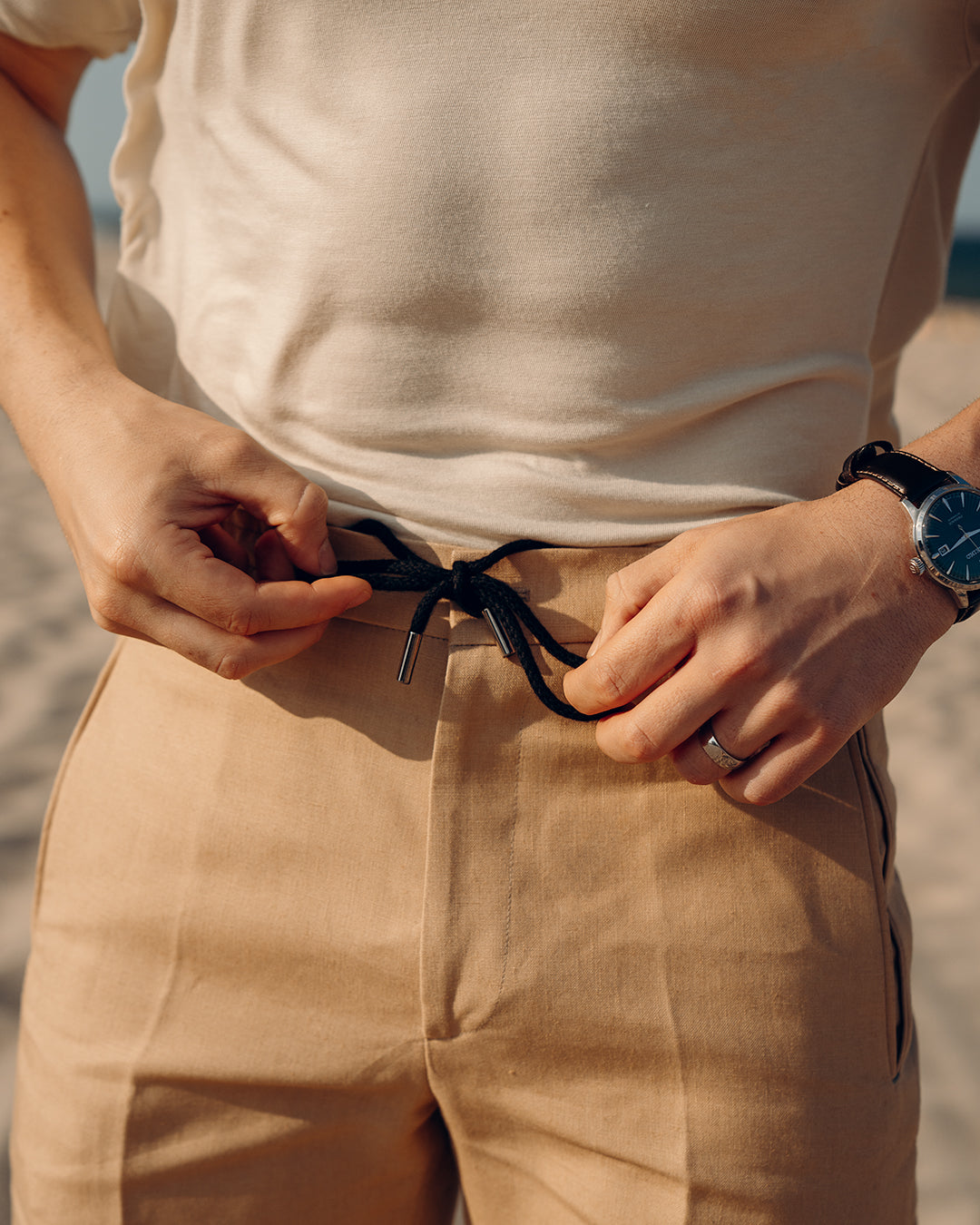
We publish where we stand on this. On our linen easy pants the rise is deliberately a little higher, because it lets the trouser sit closer to the natural waist for people who prefer to wear it there. That is a choice, not a default, and it is the reason we would rather you read the size chart than assume.
How rise changes the way a trouser hangs
Raise the rise and the leg line lengthens visually, because the eye reads the leg as starting at the waistband rather than at the hip. Pleats also behave differently. A pleat opening from a high waistband has room to release across the thigh and then close again as the leg falls. The same pleat on a low rise has nowhere to go and either gapes or lies dead.
Drop the rise and you get the opposite. The torso reads longer, the leg shorter, and the seat has less fabric above it, which is what causes the pulling across the back that people usually blame on the size. Neither is better. They are different silhouettes, and the mistake is buying one while expecting the other to happen.
There is a construction dimension to this as well. The waistband on a high rise trouser is doing more work, because there is more garment hanging off it, which is why the way it is built matters more the higher you go. We have written separately on how our trousers are made if you want the detail.
Choosing a rise for your build and your wardrobe
A few honest rules, none of them absolute.
If you are long in the leg and short in the torso, a higher rise balances you and stops the trouser looking like it starts halfway down. If you carry weight at the middle, a mid to high rise sits above the widest point and is far more comfortable than a low rise fighting to stay under it. If you are short in the leg, a higher rise buys you visual length that no amount of tailoring elsewhere will.
If you tuck your shirts, go higher. A tucked shirt into a low rise creates a bunching band of fabric at the hip that nothing will fix. If you wear your shirts out, rise matters less and you can pick on comfort alone.
And if you are between two rises, size up on rise rather than down. A trouser that sits slightly too high can be worn with a belt and looks intentional. One that sits too low cannot be corrected at all.
Where we put ours, and why
We cut toward the mid and high end of the range across the trouser line, because the fabrics we use are heavy enough to want a proper anchor. The Lorenzo is a single-pleated trouser with a clean front and slash pockets, and the pleat only works because the rise gives it somewhere to open from. Cut that same trouser two inches lower and the pleat becomes decoration.
If your rise is genuinely between sizes, or if your proportions do not match any standard block, that is exactly what made to order and made to measure exists for. Rise is one of the easiest things to change at the pattern stage and one of the hardest to change afterwards.
FAQ
What is trouser rise?
The distance from the top of the waistband to the crotch seam, measured up the front of the trouser. It decides where the waistband sits on your body and is usually published as a front rise measurement in inches.
Is 12 inch rise high-waisted?
On a men's trouser, yes. Twelve inches at the front will sit at or above the natural waist on most sizes. Check it against the waist size it belongs to, since rise scales with the block.
Is a 7 inch rise considered low rise?
Yes. Seven to roughly eight and a half inches is the low rise band, and it will sit on the hips well below the navel.
Is 9 inches mid rise?
On a mid-size trouser, yes. Nine to ten and a half inches is the mid rise band, sitting between the hip bone and the navel. On a very large waist size the same number reads lower.
Start by measuring the rise on a pair you already like, then compare it against the size chart before you buy anything. When you are ready, browse the trousers.