




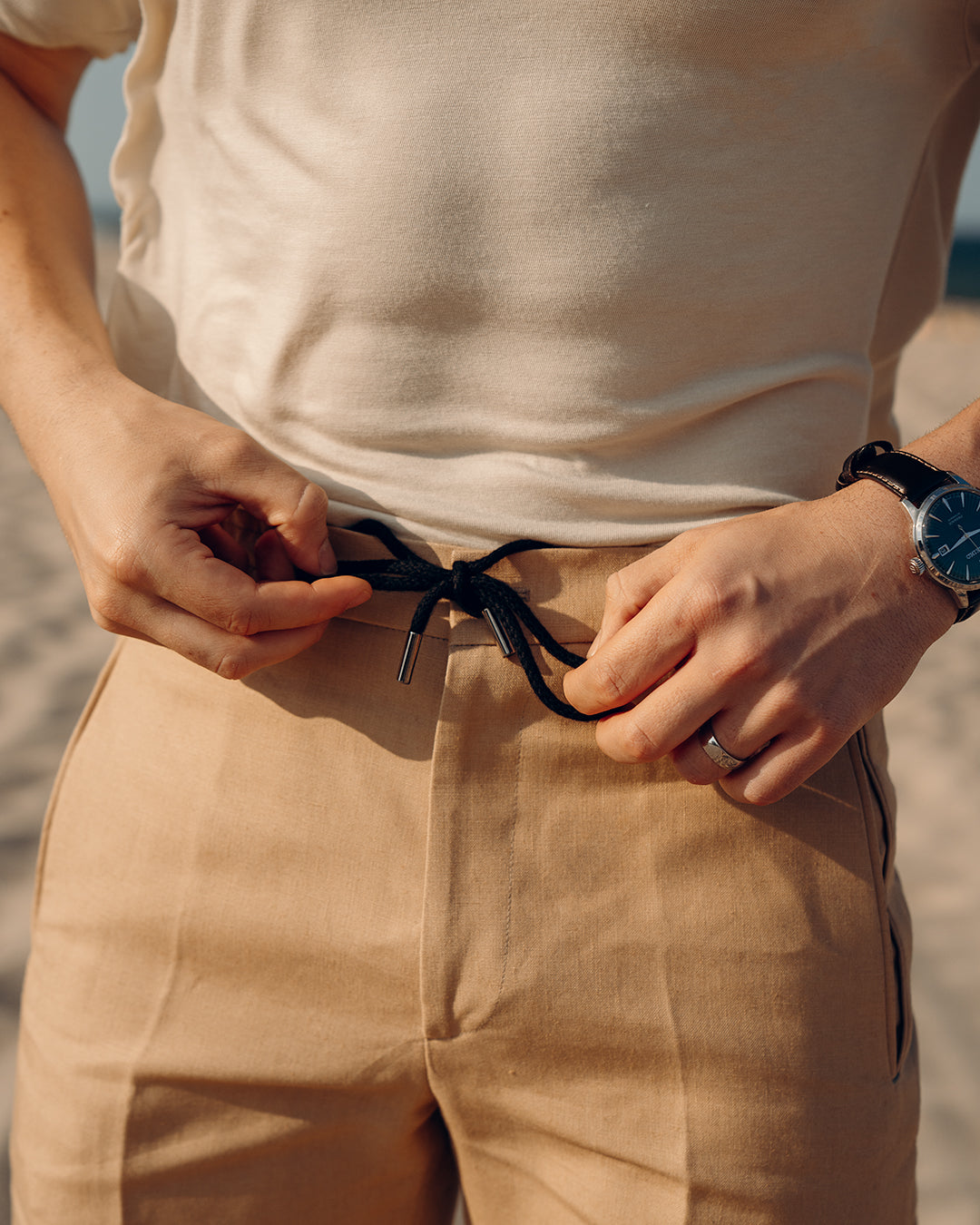



The fastest way to ruin a good pair of wool trousers is to press a crease into them badly. Too much heat and you get a permanent shine down the front of the leg that no amount of steam will lift. It is a common and entirely avoidable mistake, and it is worth understanding what the crease is before you go anywhere near it with an iron.
What the crease is and what it is for
A trouser crease is a deliberate vertical fold pressed down the center front and center back of each leg. It runs from the hem upward, typically finishing at or just below the pleat line at the front, and it is set with heat, moisture and pressure rather than being built into the pattern.
Its purpose is visual. The crease gives the eye a single straight line to follow down the leg, which makes the trouser read longer and cleaner and disguises the natural rumple that any fabric picks up through a day. It is a nineteenth century artifact of trousers being folded for shipping, kept because it turned out to look good.
Why the fabric decides whether it holds
This is the part most crease advice skips, and it is the part that actually determines your result.
A crease is a memory set into fiber. Wool holds one exceptionally well because its fibers are naturally crimped and can be reshaped with heat and moisture and then locked in as they cool. Cotton holds one poorly and releases it within hours of wear. Linen barely holds one at all. Synthetics hold one almost permanently, which is what a permanent press trouser is.
So the honest answer to why your crease keeps falling out is usually the cloth, not your technique. Our Lorenzo is 76% virgin wool with 12% silk and 12% linen, and the wool content is why it takes and keeps a line, while the linen in the blend is why that line softens rather than staying razor sharp. Our corduroy trousers blend cotton with a little wool from Drago for recovery, but corduroy has a pile and should not be creased at all, which is a fabric decision rather than a preference.
Cloth weight matters too. A heavier wool holds a crease far longer than a lightweight one, which is why summer trousers look rumpled by lunchtime and winter flannels still look pressed at the end of the day. If you want more on how fiber behaves, we have written more on wool elsewhere.
Setting a crease at home without shine or scorch
The shine people get on wool trousers is scorch. The fiber surface has been flattened and partially melted by direct heat, and it is permanent. Everything below is designed to stop that happening.
What you need
A pressing cloth, which can simply be a clean cotton tea towel or a piece of plain cotton sheet, an iron with a working steam function, and a flat surface. The pressing cloth is not optional on wool. It is the single thing standing between you and a shiny leg.
The sequence
1. Turn the trousers inside out and press the seams and pockets flat first, so you are not pressing creases into cloth that is already sitting wrong.
2. Turn them right side out and lay one leg flat, lining up the inseam with the outseam so the leg folds naturally. That fold is where the crease belongs. Do not invent a line, find the one the trouser wants.
3. Lay the pressing cloth over the leg. Set the iron to the wool setting, not higher.
4. Press down for a few seconds and lift. Do not slide the iron back and forth, which stretches the cloth and distorts the leg.
5. Use steam generously. The moisture is what reshapes the fiber. Heat alone just scorches it.
6. Let the leg cool completely before you move it. The crease sets as the wool cools, and lifting it while warm undoes most of the work.
Repeat on the back of the leg and then the other leg. If the old crease is in the wrong place, dampen it and press it out first with the cloth, let it dry fully, then set the new one.
A note on the front. Pressing is built into the way our trousers are made in the first place rather than applied at the end, which is a large part of why they arrive with a clean line. If you want that detail, read how our trousers are made.
Keeping one between wears
Most of the work is not ironing. It is storage.
Hang trousers by the cuff, upside down, from a clamp hanger. Gravity then pulls the leg straight from the hem and the crease reasserts itself overnight without any heat at all. Folding them over a bar puts a horizontal crease across the knee that fights the vertical one, which is exactly what you do not want.
Rest them between wears. Wool recovers its shape given a day hanging in air, and a rested trouser needs pressing far less often. Hang them somewhere with room rather than crushed between two coats.
And press less than you think. Every pressing is heat on the fiber, and a trouser pressed weekly for years will wear thin at the crease line before it wears out anywhere else. Steam alone, with no iron contact, revives a tired crease most of the time.
Whether a permanent crease is worth it
Permanent crease trousers exist and they work by chemically treating the fabric or by relying on synthetic content that holds a fold indefinitely. If you want a line that never needs attention, that is how you get one.
The trade is that the treatment stiffens the hand of the cloth and takes away the drape that makes a good wool trouser worth owning. It also means the crease is where it is forever, so if the trouser is ever altered or the crease is off, you are stuck. On a workwear trouser it is a sensible choice. On a trouser you bought for the cloth, it defeats the purpose.
When a crease is wrong for the trouser
Not every trouser wants one. Corduroy has a pile that flattens and marks under an iron. Casual cottons and chinos read stiff and overdressed with a hard crease. Anything cut relaxed or drawstringed looks confused with a formal line down it. And most jeans, obviously.
If the trouser is tailored, in wool or a wool blend, with a proper rise, a crease belongs on it. If it is casual, cotton, or has a texture, leave it alone. Browse the trousers and you will notice we cut both kinds.
FAQ
What is a crease in trousers?
A deliberate vertical fold pressed down the center front and back of each leg, set with heat, moisture and pressure. It gives the eye a straight line to follow and makes the leg read longer and cleaner.
How to make a crease on trousers?
Lay the leg flat with the inseam aligned to the outseam, cover it with a pressing cloth, use the wool setting with plenty of steam, press and lift rather than sliding, and let the cloth cool completely before moving it.
What are the folds on trousers called?
The vertical line down the leg is the crease. The folds at the waistband are pleats, which are a construction feature rather than something you press in.
Is it fashionable to have a crease in your trousers?
On tailored wool trousers, yes, and it has been continuously for over a century. On casual cotton or textured cloth it looks out of place, so let the trouser decide rather than the trend.
Do men still wear creases in their pants?
Yes, on tailored trousers. What has changed is that casual trousers are now generally worn uncreased, so the crease has become a signal of a dressier garment rather than a default on everything.
If your crease keeps dropping out, look at the cloth before you buy a better iron. And if you want a trouser that holds one, start with the wool content.